PreFlop Camp — free GTO preflop poker trainer中文
Heads-Up Push/Fold Chart 20bb (Nash)
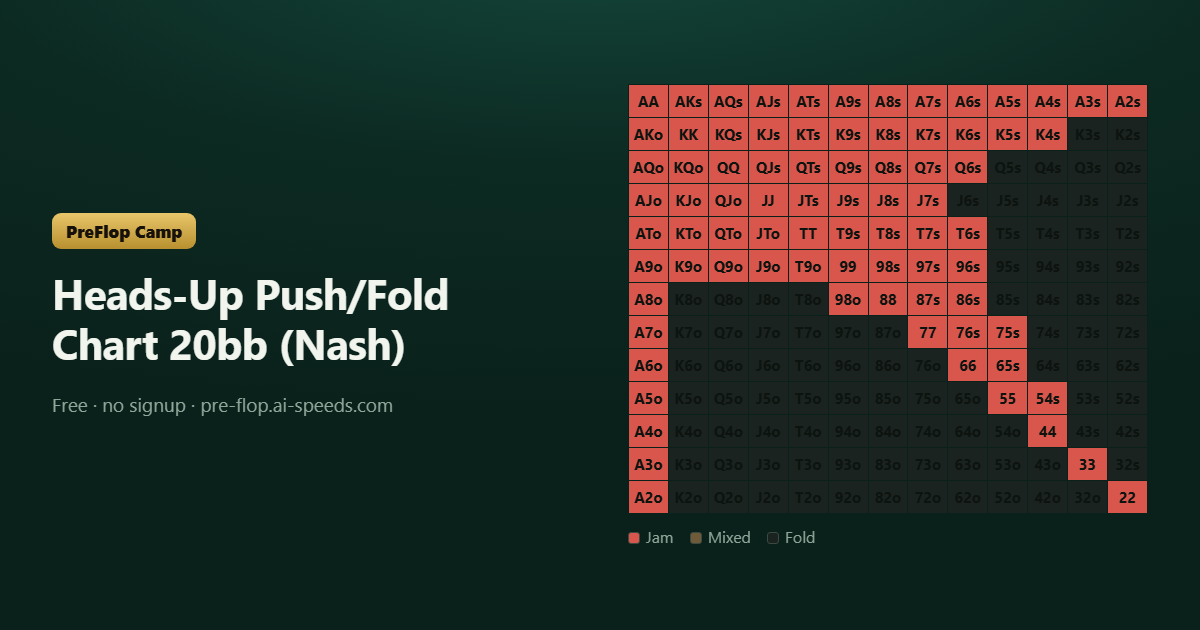
Heads-up at 20 big blinds: the Nash push/fold solution for both sides. The small blind jams 40% and the big blind calls 22% — both shown as full 13×13 charts with the expected value of every hand in big blinds, including the hands that are close to a coin flip.
Small blind — jamming range — 40.0%
| AA | AKs | AQs | AJs | ATs | A9s | A8s | A7s | A6s | A5s | A4s | A3s | A2s |
| AKo | KK | KQs | KJs | KTs | K9s | K8s | K7s | K6s | K5s | K4s | K3s | K2s |
| AQo | KQo | QJs | QTs | Q9s | Q8s | Q7s | Q6s | Q5s | Q4s | Q3s | Q2s | |
| AJo | KJo | QJo | JJ | JTs | J9s | J8s | J7s | J6s | J5s | J4s | J3s | J2s |
| ATo | KTo | QTo | JTo | TT | T9s | T8s | T7s | T6s | T5s | T4s | T3s | T2s |
| A9o | K9o | Q9o | J9o | T9o | 99 | 98s | 97s | 96s | 95s | 94s | 93s | 92s |
| A8o | K8o | Q8o | J8o | T8o | 98o | 88 | 87s | 86s | 85s | 84s | 83s | 82s |
| A7o | K7o | Q7o | J7o | T7o | 97o | 87o | 77 | 76s | 75s | 74s | 73s | 72s |
| A6o | K6o | Q6o | J6o | T6o | 96o | 86o | 76o | 66 | 65s | 64s | 63s | 62s |
| A5o | K5o | Q5o | J5o | T5o | 95o | 85o | 75o | 65o | 55 | 54s | 53s | 52s |
| A4o | K4o | Q4o | J4o | T4o | 94o | 84o | 74o | 64o | 54o | 44 | 43s | 42s |
| A3o | K3o | Q3o | J3o | T3o | 93o | 83o | 73o | 63o | 53o | 43o | 33 | 32s |
| A2o | K2o | Q2o | J2o | T2o | 92o | 82o | 72o | 62o | 52o | 42o | 32o | 22 |
JamMixedFold
Big blind — calling range — 21.7%
| AA | AKs | AQs | AJs | ATs | A9s | A8s | A7s | A6s | A5s | A4s | A3s | A2s |
| AKo | KK | KQs | KJs | KTs | K9s | K8s | K7s | K6s | K5s | K4s | K3s | K2s |
| AQo | KQo | QJs | QTs | Q9s | Q8s | Q7s | Q6s | Q5s | Q4s | Q3s | Q2s | |
| AJo | KJo | QJo | JJ | JTs | J9s | J8s | J7s | J6s | J5s | J4s | J3s | J2s |
| ATo | KTo | QTo | JTo | TT | T9s | T8s | T7s | T6s | T5s | T4s | T3s | T2s |
| A9o | K9o | Q9o | J9o | T9o | 99 | 98s | 97s | 96s | 95s | 94s | 93s | 92s |
| A8o | K8o | Q8o | J8o | T8o | 98o | 88 | 87s | 86s | 85s | 84s | 83s | 82s |
| A7o | K7o | Q7o | J7o | T7o | 97o | 87o | 77 | 76s | 75s | 74s | 73s | 72s |
| A6o | K6o | Q6o | J6o | T6o | 96o | 86o | 76o | 66 | 65s | 64s | 63s | 62s |
| A5o | K5o | Q5o | J5o | T5o | 95o | 85o | 75o | 65o | 55 | 54s | 53s | 52s |
| A4o | K4o | Q4o | J4o | T4o | 94o | 84o | 74o | 64o | 54o | 44 | 43s | 42s |
| A3o | K3o | Q3o | J3o | T3o | 93o | 83o | 73o | 63o | 53o | 43o | 33 | 32s |
| A2o | K2o | Q2o | J2o | T2o | 92o | 82o | 72o | 62o | 52o | 42o | 32o | 22 |
CallMixedFold
Expected value per hand (bb)
Highest EV: AA +3.73 KK +3.24 QQ +2.94 JJ +2.64 AKs +2.37 TT +2.36 AKo +2.24 AQs +2.11
Barely +EV (near-indifferent): T6s +0.02 Q9o +0.02 98o +0.02 54s +0.02 75s +0.03 K4s +0.04 K9o +0.04 Q6s +0.05
Looks playable, quietly loses: J6s -0.01 T8o -0.02 85s -0.03 Q4s -0.04 87o -0.04 J5s -0.05 64s -0.05 K2s -0.06
At twenty blinds the small blind jams 40% and the big blind calls 22%. This is past the point where jamming is the best strategy — but it is exactly the point where knowing the jamming range protects you from getting it in badly.
The two ranges are now far apart: the small blind risks 20bb to win 1.5bb, and the big blind needs a genuinely good hand to pay it off. That asymmetry means a lot of the small blind's jams are still profitable purely on folds — but the downside when called has grown four-fold since 5bb.
If your opponent shoves 20bb, they are usually either following a chart or making a mistake. The chart tells you which hands beat a correct 40% range; anything looser than that from them, and you can widen. Do not widen on a hunch.
Save or print this chart
FAQ
What is the correct heads-up shoving range at 20bb?
The small blind jams about 40% at 20bb; the full Nash range is on this page with the EV of every hand. Hands showing between +0.00 and +0.03bb are close to indifferent — shoving or folding them costs almost nothing in the long run.
Do these heads-up charts assume the big blind plays correctly?
Yes — both ranges are the equilibrium against each other (the big blind calls 22% here). If your opponent calls too wide, tighten your jams to value; if they fold too much, widen toward any two cards. The equilibrium is the baseline you deviate from, not a target to hit against a bad player.
Related charts
Heads-Up Push/Fold Chart 5bb (Nash)Heads-Up Push/Fold Chart 8bb (Nash)Heads-Up Push/Fold Chart 10bb (Nash)Heads-Up Push/Fold Chart 12bb (Nash)UTG Opening Range (6-Max)BB Defence vs Button Open (6-Max)
The trainer that draws these charts is a free download — core training is free, no signup, works offline.
Get it on Google PlayDownload on the App Store
Push/fold tables are a self-computed chip-EV Nash equilibrium (Monte-Carlo hand-class equity, 25,000 samples, seed 1234). Known limits, stated plainly: they ignore ICM, and the model does not apply card removal to the callers' range — so offsuit aces, which block a caller's AA/AK/AQ/AJ, are slightly undervalued. Exploitability for this stack: 0 bb/hand.
Updated 2026-09-12