PreFlop Camp — free GTO preflop poker trainer中文
BB Calling Range vs a 20bb Button Shove
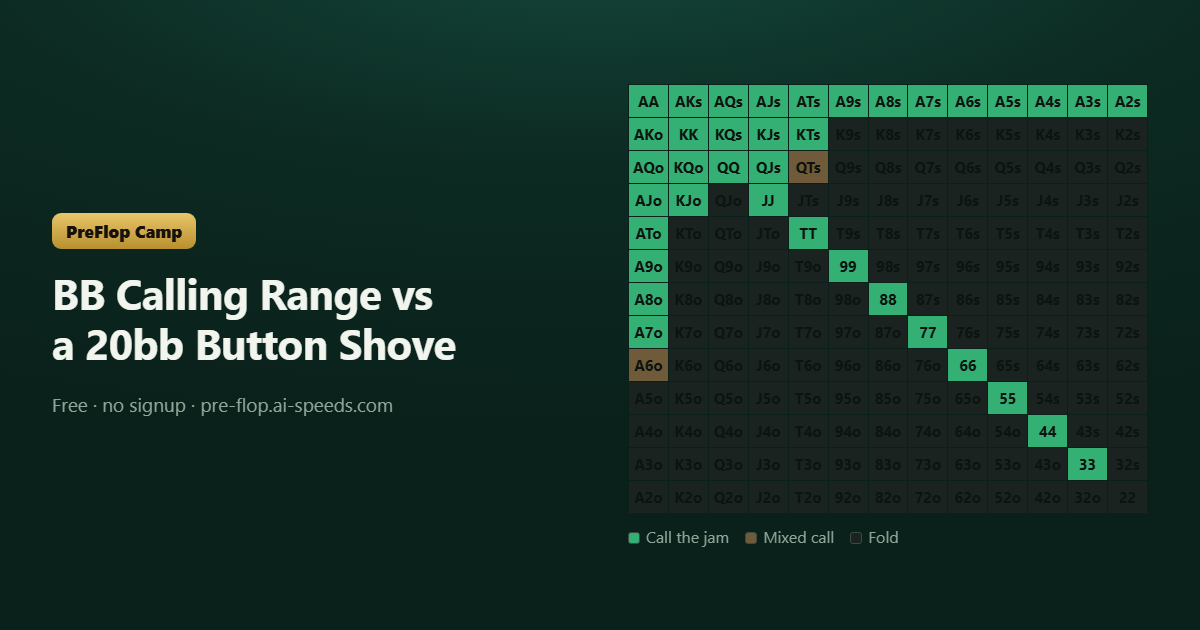
Against a 20bb button all-in you call only about 19% of hands (39 hand classes) from the big blind. You are risking 19bb to win about 41bb, which needs roughly 46% equity — and at this depth a shove usually means a genuinely strong hand.
Chart
| AA | AKs | AQs | AJs | ATs | A9s | A8s | A7s | A6s | A5s | A4s | A3s | A2s |
| AKo | KK | KQs | KJs | KTs | K9s | K8s | K7s | K6s | K5s | K4s | K3s | K2s |
| AQo | KQo | QJs | QTs | Q9s | Q8s | Q7s | Q6s | Q5s | Q4s | Q3s | Q2s | |
| AJo | KJo | QJo | JJ | JTs | J9s | J8s | J7s | J6s | J5s | J4s | J3s | J2s |
| ATo | KTo | QTo | JTo | TT | T9s | T8s | T7s | T6s | T5s | T4s | T3s | T2s |
| A9o | K9o | Q9o | J9o | T9o | 99 | 98s | 97s | 96s | 95s | 94s | 93s | 92s |
| A8o | K8o | Q8o | J8o | T8o | 98o | 88 | 87s | 86s | 85s | 84s | 83s | 82s |
| A7o | K7o | Q7o | J7o | T7o | 97o | 87o | 77 | 76s | 75s | 74s | 73s | 72s |
| A6o | K6o | Q6o | J6o | T6o | 96o | 86o | 76o | 66 | 65s | 64s | 63s | 62s |
| A5o | K5o | Q5o | J5o | T5o | 95o | 85o | 75o | 65o | 55 | 54s | 53s | 52s |
| A4o | K4o | Q4o | J4o | T4o | 94o | 84o | 74o | 64o | 54o | 44 | 43s | 42s |
| A3o | K3o | Q3o | J3o | T3o | 93o | 83o | 73o | 63o | 53o | 43o | 33 | 32s |
| A2o | K2o | Q2o | J2o | T2o | 92o | 82o | 72o | 62o | 52o | 42o | 32o | 22 |
Call the jamMixed callFold
18.8% of hands (250 combos) · 39 hand classes
Twenty blinds is deep enough that shoving is no longer standard, and that changes everything about how you should call. A player who jams 20bb is either following a jam-or-fold chart correctly — in which case they have a strong range — or they are making a mistake by removing all their own post-flop equity. Against the first player you need the range below; against the second, you can call a little wider, but only if you are sure.
The calling range has narrowed to the hands that beat a real range in a raw showdown: medium and big pairs, AJ+, and KQ. The small pairs are gone. They were never good against strong hands — they were good against the wide, bluff-heavy shoves you get at 10bb, and those shoves do not exist here.
The counterintuitive part is that you fold more as your equity in the pot grows. That is correct: the dead money (your 1bb blind) is a constant, but the amount you must risk to claim it has doubled. Price, not hand strength, is what moved.
Save or print this chart
FAQ
How wide should the big blind call a 20bb all-in?
About 19% — roughly 39 hand classes: medium-to-big pairs, AJ and better, KQ. You are calling 19bb to win about 41bb, so you need around 46% equity, and a correct 20bb shoving range (33% from the button) is strong enough that only genuinely good hands clear that bar.
Is a 20bb shove from the button a mistake?
Usually, yes — at 20bb the button has room to raise, see a flop and still fold, and shoving throws all of that away. But be careful: a player who jams 20bb because a chart told them to has a strong range (33%), and calling wide against them is the mistake. Only widen when you have a specific reason to think they are shoving badly.
Related charts
BB Calling Range vs a 10bb Button ShoveBB Calling Range vs a 15bb Button ShoveUTG Opening Range (6-Max)BB Defence vs Button Open (6-Max)
The trainer that draws these charts is a free download — core training is free, no signup, works offline.
Get it on Google PlayDownload on the App Store
Push/fold tables are a self-computed chip-EV Nash equilibrium (Monte-Carlo hand-class equity, 25,000 samples, seed 1234). Known limits, stated plainly: they ignore ICM, and the model does not apply card removal to the callers' range — so offsuit aces, which block a caller's AA/AK/AQ/AJ, are slightly undervalued. Exploitability for this stack: 0.04 bb/hand.
Updated 2026-09-12