PreFlop Camp — free GTO preflop poker trainer中文
BB Calling Range vs a 15bb Button Shove
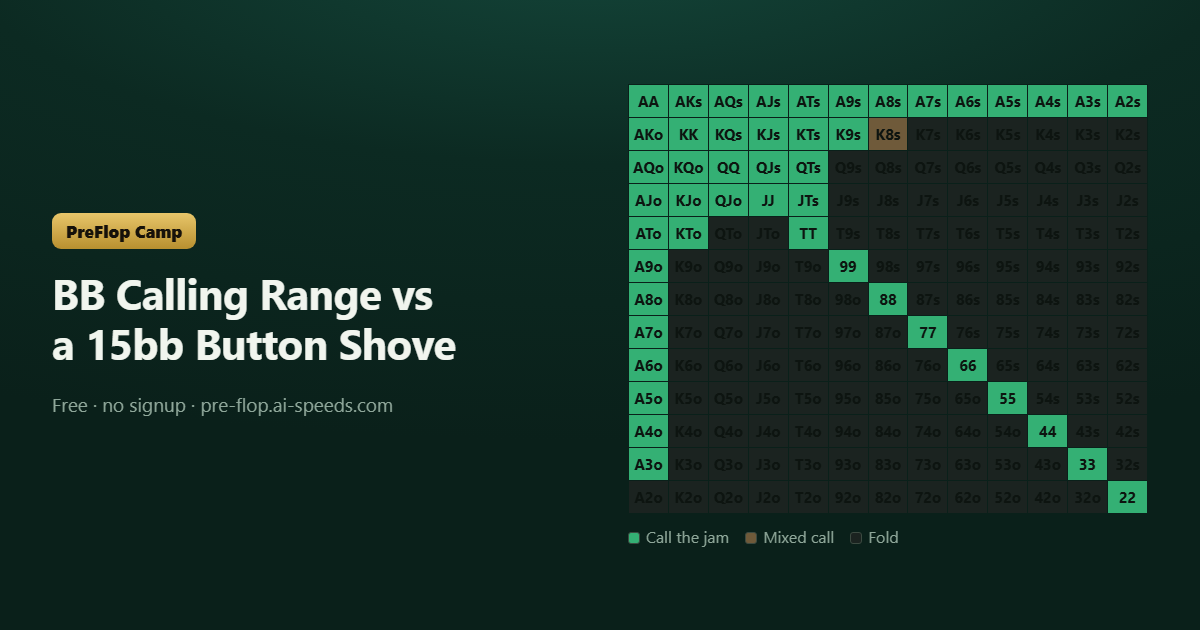
Against a 15bb button all-in you call about 25% of hands from the big blind (48 hand classes) — much tighter than at 10bb. You are risking 14bb to win about 31bb, so you need roughly 45% equity, and the button is jamming a tighter 36%.
Chart
| AA | AKs | AQs | AJs | ATs | A9s | A8s | A7s | A6s | A5s | A4s | A3s | A2s |
| AKo | KK | KQs | KJs | KTs | K9s | K8s | K7s | K6s | K5s | K4s | K3s | K2s |
| AQo | KQo | QJs | QTs | Q9s | Q8s | Q7s | Q6s | Q5s | Q4s | Q3s | Q2s | |
| AJo | KJo | QJo | JJ | JTs | J9s | J8s | J7s | J6s | J5s | J4s | J3s | J2s |
| ATo | KTo | QTo | JTo | TT | T9s | T8s | T7s | T6s | T5s | T4s | T3s | T2s |
| A9o | K9o | Q9o | J9o | T9o | 99 | 98s | 97s | 96s | 95s | 94s | 93s | 92s |
| A8o | K8o | Q8o | J8o | T8o | 98o | 88 | 87s | 86s | 85s | 84s | 83s | 82s |
| A7o | K7o | Q7o | J7o | T7o | 97o | 87o | 77 | 76s | 75s | 74s | 73s | 72s |
| A6o | K6o | Q6o | J6o | T6o | 96o | 86o | 76o | 66 | 65s | 64s | 63s | 62s |
| A5o | K5o | Q5o | J5o | T5o | 95o | 85o | 75o | 65o | 55 | 54s | 53s | 52s |
| A4o | K4o | Q4o | J4o | T4o | 94o | 84o | 74o | 64o | 54o | 44 | 43s | 42s |
| A3o | K3o | Q3o | J3o | T3o | 93o | 83o | 73o | 63o | 53o | 43o | 33 | 32s |
| A2o | K2o | Q2o | J2o | T2o | 92o | 82o | 72o | 62o | 52o | 42o | 32o | 22 |
Call the jamMixed callFold
25.3% of hands (335 combos) · 48 hand classes
Two things move against you at once when the stack grows from 10bb to 15bb: the price gets worse (you must call 14bb instead of 9bb for a pot that grew by less), and the button's jamming range tightens from 43% to 36%. Both effects push in the same direction, which is why the calling range falls from 35% to 25%.
The hands that survive are the ones with raw showdown strength against a real range: medium pairs and up, ace-ten and better, KQ. The speculative calls that worked at 10bb — the smallest pairs, weak aces, suited kings — fall away because they were only ever calling on price, and the price is gone.
A subtle point most players miss: at this depth the button is also jamming fewer bluffs, so your marginal calls are running into more genuine hands. Do not extrapolate a "he shoves a lot" read from the 10bb chart to a 15bb spot — the same player shoving correctly is shoving a different, stronger range.
Save or print this chart
FAQ
How wide should I call a 15bb shove in the big blind?
About 25% — roughly 48 hand classes: medium pairs and up, ace-ten and better, KQ and the strongest suited broadways. That is far tighter than your calling range against a 10bb jam (35%), because the price is worse and the button's jamming range is tighter.
Why do I call less at 15bb than at 10bb?
Two reasons stack up. You must call 14bb instead of 9bb for a pot that has not grown proportionally, so you need more equity (~45% instead of ~42%); and the button jams 36% instead of 43%, so the range you are up against is stronger. Both say: fold more.
Related charts
BB Calling Range vs a 10bb Button ShoveBB Calling Range vs a 20bb Button ShoveUTG Opening Range (6-Max)BB Defence vs Button Open (6-Max)
The trainer that draws these charts is a free download — core training is free, no signup, works offline.
Get it on Google PlayDownload on the App Store
Push/fold tables are a self-computed chip-EV Nash equilibrium (Monte-Carlo hand-class equity, 25,000 samples, seed 1234). Known limits, stated plainly: they ignore ICM, and the model does not apply card removal to the callers' range — so offsuit aces, which block a caller's AA/AK/AQ/AJ, are slightly undervalued. Exploitability for this stack: 0.036 bb/hand.
Updated 2026-09-12