PreFlop Camp — free GTO preflop poker trainer中文
BB Calling Range vs a 10bb Button Shove
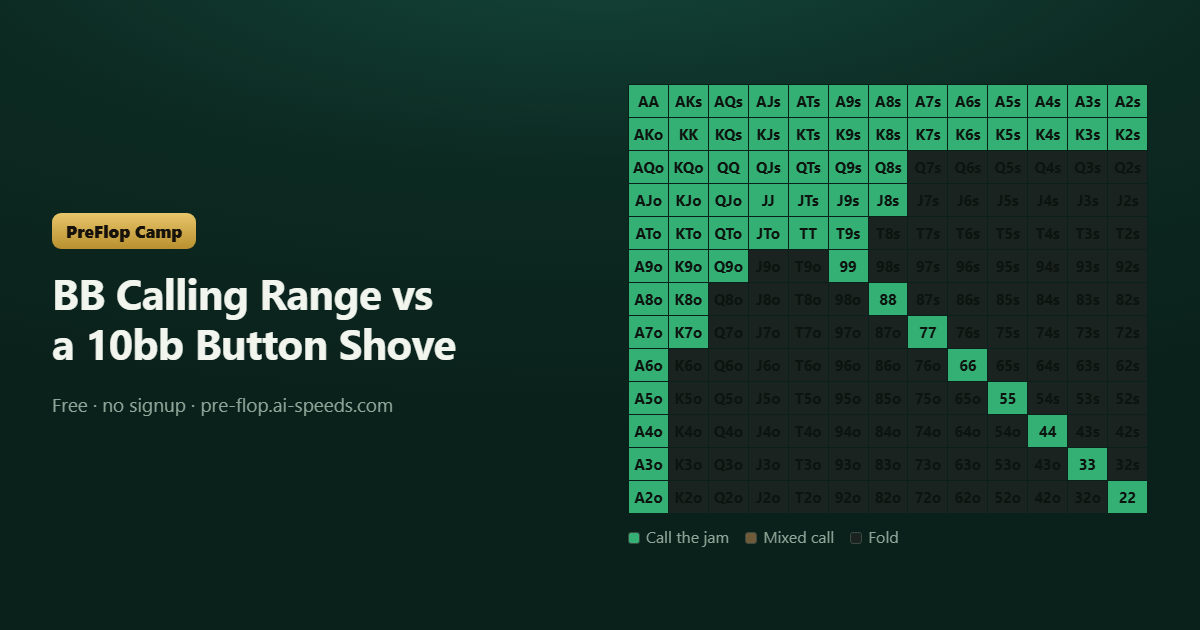
When the button moves all in for 10 big blinds and you are in the big blind, you call with about 35% of hands (66 hand classes). You are getting a good price — 1bb is already yours and you are calling 9bb to win a pot of about 21bb — but the button is jamming 43%, so most hands still fold.
Chart
| AA | AKs | AQs | AJs | ATs | A9s | A8s | A7s | A6s | A5s | A4s | A3s | A2s |
| AKo | KK | KQs | KJs | KTs | K9s | K8s | K7s | K6s | K5s | K4s | K3s | K2s |
| AQo | KQo | QJs | QTs | Q9s | Q8s | Q7s | Q6s | Q5s | Q4s | Q3s | Q2s | |
| AJo | KJo | QJo | JJ | JTs | J9s | J8s | J7s | J6s | J5s | J4s | J3s | J2s |
| ATo | KTo | QTo | JTo | TT | T9s | T8s | T7s | T6s | T5s | T4s | T3s | T2s |
| A9o | K9o | Q9o | J9o | T9o | 99 | 98s | 97s | 96s | 95s | 94s | 93s | 92s |
| A8o | K8o | Q8o | J8o | T8o | 98o | 88 | 87s | 86s | 85s | 84s | 83s | 82s |
| A7o | K7o | Q7o | J7o | T7o | 97o | 87o | 77 | 76s | 75s | 74s | 73s | 72s |
| A6o | K6o | Q6o | J6o | T6o | 96o | 86o | 76o | 66 | 65s | 64s | 63s | 62s |
| A5o | K5o | Q5o | J5o | T5o | 95o | 85o | 75o | 65o | 55 | 54s | 53s | 52s |
| A4o | K4o | Q4o | J4o | T4o | 94o | 84o | 74o | 64o | 54o | 44 | 43s | 42s |
| A3o | K3o | Q3o | J3o | T3o | 93o | 83o | 73o | 63o | 53o | 43o | 33 | 32s |
| A2o | K2o | Q2o | J2o | T2o | 92o | 82o | 72o | 62o | 52o | 42o | 32o | 22 |
Call the jamMixed callFold
35.1% of hands (466 combos) · 66 hand classes
This is the mirror image of the jamming chart, and it is the half most players never learn. The price you are getting means you need roughly 42% equity to call — that sounds like a lot, but against a 43% shoving range, hands as weak as K9s and A7o clear it. Folding a hand that has 45% equity for the right price is the most expensive mistake in short-stack poker, and it is invisible.
The calling range is dominated by two families: any pair (even 22 is a call — it is a coin flip against two overcards and ahead of every unpaired hand that is not two overcards), and ace-x. Suited connectors that would happily play a flop from a raise are folds here: with no implied odds and no fold equity, 76s is simply behind.
Watch how the calling range shrinks as stacks get deeper: 35% at 10bb, 25% at 15bb, 19% at 20bb. The price gets worse every blind you add, because the amount you must call grows while the dead money in the middle stays the same.
Save or print this chart
FAQ
What hands should I call a 10bb button shove with from the big blind?
About 35% of hands — all pairs, most aces, strong kings and the better suited broadways. You need roughly 42% equity because you are calling 9bb to win about 21bb, and against a 43% jamming range plenty of hands clear that bar. The chart lists all 66 hand classes with their EV.
Should I call an all-in with 22 in the big blind?
Against a 10bb button jam, yes. A small pair is at worst a slight underdog to two overcards (about 48%) and a big favourite against everything else in a 43% range. At the price you are getting, that is a comfortable call — folding it is a real, if invisible, loss.
Related charts
BB Calling Range vs a 15bb Button ShoveBB Calling Range vs a 20bb Button ShoveUTG Opening Range (6-Max)BB Defence vs Button Open (6-Max)
The trainer that draws these charts is a free download — core training is free, no signup, works offline.
Get it on Google PlayDownload on the App Store
Push/fold tables are a self-computed chip-EV Nash equilibrium (Monte-Carlo hand-class equity, 25,000 samples, seed 1234). Known limits, stated plainly: they ignore ICM, and the model does not apply card removal to the callers' range — so offsuit aces, which block a caller's AA/AK/AQ/AJ, are slightly undervalued. Exploitability for this stack: 0.028 bb/hand.
Updated 2026-09-12