PreFlop Camp — free GTO preflop poker trainer中文
Small Blind Opening Range (6-Max & 9-Max)
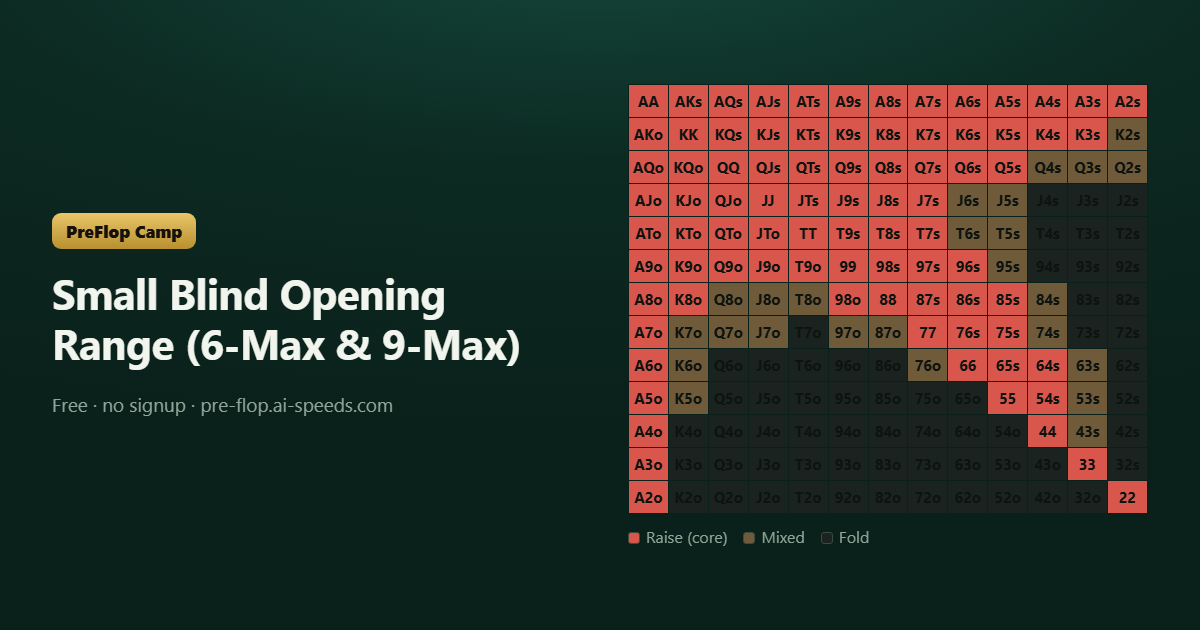
When it folds to the small blind you raise about 42% of hands (554 combos), up to ~56% with the mixed band. You already have half a blind in and only one player left to beat — but you will be out of position for the entire hand if the big blind calls.
Chart
| AA | AKs | AQs | AJs | ATs | A9s | A8s | A7s | A6s | A5s | A4s | A3s | A2s |
| AKo | KK | KQs | KJs | KTs | K9s | K8s | K7s | K6s | K5s | K4s | K3s | K2s |
| AQo | KQo | QJs | QTs | Q9s | Q8s | Q7s | Q6s | Q5s | Q4s | Q3s | Q2s | |
| AJo | KJo | QJo | JJ | JTs | J9s | J8s | J7s | J6s | J5s | J4s | J3s | J2s |
| ATo | KTo | QTo | JTo | TT | T9s | T8s | T7s | T6s | T5s | T4s | T3s | T2s |
| A9o | K9o | Q9o | J9o | T9o | 99 | 98s | 97s | 96s | 95s | 94s | 93s | 92s |
| A8o | K8o | Q8o | J8o | T8o | 98o | 88 | 87s | 86s | 85s | 84s | 83s | 82s |
| A7o | K7o | Q7o | J7o | T7o | 97o | 87o | 77 | 76s | 75s | 74s | 73s | 72s |
| A6o | K6o | Q6o | J6o | T6o | 96o | 86o | 76o | 66 | 65s | 64s | 63s | 62s |
| A5o | K5o | Q5o | J5o | T5o | 95o | 85o | 75o | 65o | 55 | 54s | 53s | 52s |
| A4o | K4o | Q4o | J4o | T4o | 94o | 84o | 74o | 64o | 54o | 44 | 43s | 42s |
| A3o | K3o | Q3o | J3o | T3o | 93o | 83o | 73o | 63o | 53o | 43o | 33 | 32s |
| A2o | K2o | Q2o | J2o | T2o | 92o | 82o | 72o | 62o | 52o | 42o | 32o | 22 |
Raise (core)MixedFold
The range: 22+, A2s+, K3s+, Q5s+, J7s+, T7s+, 96s+, 85s+, 75s+, 64s+, 54s, A2o+, K8o+, Q9o+, J9o+, T9o, 98o
41.8% of hands (554 combos) · +14.2% of hands (188 combos)
The mixed band (open part of the time)
K2s Q4s Q3s Q2s J5s J6s T5s T6s 95s 84s 74s 63s 53s 43s K7o K6o K5o Q7o Q8o J7o J8o T8o 97o 87o 76o
The small blind is a strange seat: the widest single-opponent spot in the game and the worst position at the same time. You are getting a good price to attack one player, and the big blind folds often enough that a raise shows an immediate profit with almost any two cards. But if the big blind calls or 3-bets — and a good big blind defends more than half the time — you play every post-flop street first.
That is why the range is wide but shaped differently from the button: it leans much harder on suited hands and on hands that hold their value out of position. Suited aces (all of them), suited kings down to K3s and suited connectors are core opens; the offsuit filler (Q7o, J7o, T8o, 97o, 76o) sits in the mixed band and is the first thing to cut against a big blind who defends aggressively.
The alternative strategy — limping part of the range — is genuinely viable and used by solvers at deeper stacks, but it is much harder to play well, and against most opponents a raise-or-fold strategy at this width captures nearly all of the available EV with far less complexity.
Save or print this chart
FAQ
How wide should the small blind open when it folds to them?
About 42% as the core raising range (554 combos), stretching to ~56% including the marginal offsuit hands solvers mix. That is much wider than any other non-button seat because only one player is left to act — but it is tighter than the button because you have no position post-flop.
Should I limp or raise from the small blind?
A raise-or-fold strategy at around 42% is simpler and captures most of the EV. Solvers do use a limping range in deep-stacked cash games, but it requires a well-constructed follow-up strategy for every board — get raise-or-fold right first, and only add limps once the rest of your preflop game is solid.
Related charts
UTG Opening Range (6-Max)Hijack Opening Range (6-Max)Cutoff Opening Range (6-Max & 9-Max)Button Opening Range (6-Max & 9-Max)BB Defence vs Button Open (6-Max)20bb Push/Fold Chart (9-Max Nash)
The trainer that draws these charts is a free download — core training is free, no signup, works offline.
Get it on Google PlayDownload on the App Store
Cash-game ranges are a curated GTO reference, drilled question-by-question in the trainer. The mixed band lists hands solvers play only part of the time.
Updated 2026-09-12