PreFlop Camp — free GTO preflop poker trainer中文
BB Defence vs Cutoff Open (6-Max)
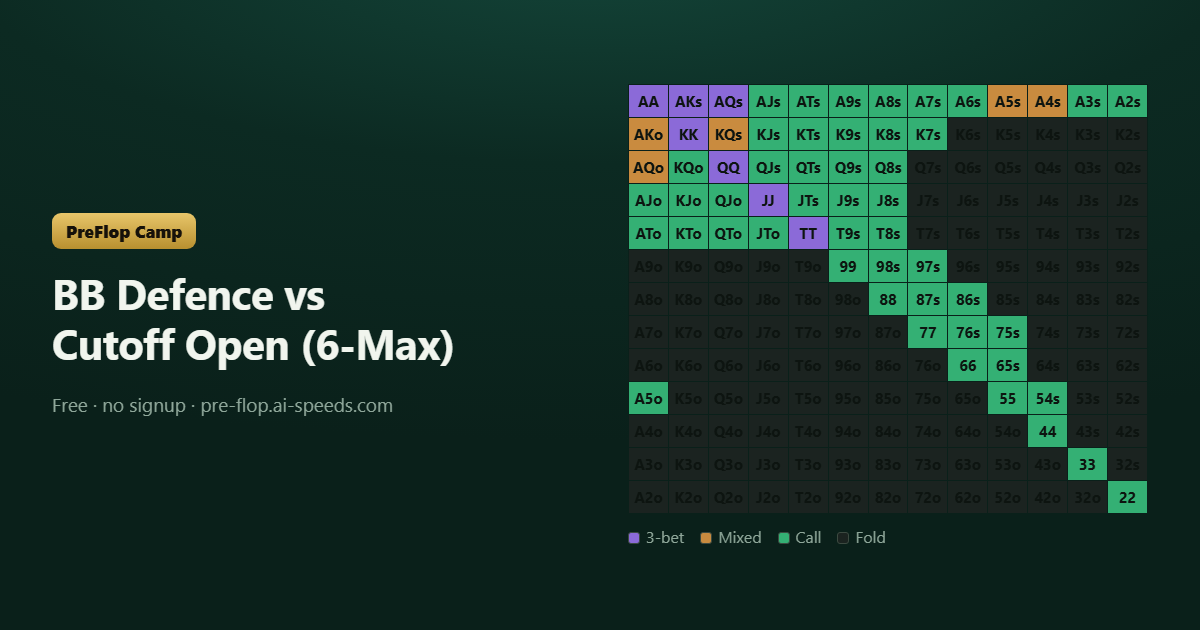
Against a cutoff open you defend about 42% of hands from the big blind — 3-bet roughly 6% (TT+, AJs+, KQs, A5s–A4s, AQo+) and call about 36%. Tighter than against the button (53%), because the cutoff opens 29% instead of 43%.
Chart
| AA | AKs | AQs | AJs | ATs | A9s | A8s | A7s | A6s | A5s | A4s | A3s | A2s |
| AKo | KK | KQs | KJs | KTs | K9s | K8s | K7s | K6s | K5s | K4s | K3s | K2s |
| AQo | KQo | QJs | QTs | Q9s | Q8s | Q7s | Q6s | Q5s | Q4s | Q3s | Q2s | |
| AJo | KJo | QJo | JJ | JTs | J9s | J8s | J7s | J6s | J5s | J4s | J3s | J2s |
| ATo | KTo | QTo | JTo | TT | T9s | T8s | T7s | T6s | T5s | T4s | T3s | T2s |
| A9o | K9o | Q9o | J9o | T9o | 99 | 98s | 97s | 96s | 95s | 94s | 93s | 92s |
| A8o | K8o | Q8o | J8o | T8o | 98o | 88 | 87s | 86s | 85s | 84s | 83s | 82s |
| A7o | K7o | Q7o | J7o | T7o | 97o | 87o | 77 | 76s | 75s | 74s | 73s | 72s |
| A6o | K6o | Q6o | J6o | T6o | 96o | 86o | 76o | 66 | 65s | 64s | 63s | 62s |
| A5o | K5o | Q5o | J5o | T5o | 95o | 85o | 75o | 65o | 55 | 54s | 53s | 52s |
| A4o | K4o | Q4o | J4o | T4o | 94o | 84o | 74o | 64o | 54o | 44 | 43s | 42s |
| A3o | K3o | Q3o | J3o | T3o | 93o | 83o | 73o | 63o | 53o | 43o | 33 | 32s |
| A2o | K2o | Q2o | J2o | T2o | 92o | 82o | 72o | 62o | 52o | 42o | 32o | 22 |
3-betMixedCallFold
3-bet: TT+, AJs+, KQs, A5s-A4s, AQo+
5.9% of hands (78 combos)
Call: 22-99, A6s-ATs, A2s-A3s, K2s-KJs, Q5s-QJs, J7s-JTs, T7s+, 96s+, 85s+, 74s+, 64s+, 53s+, 43s, A2o-AJo, K9o-KQo, Q9o+, J9o+, T9o, 98o
36.2% of hands (480 combos)
The rule that generates every big-blind defending range is simple: defend against strength, not against position. The cutoff opens 29% of hands versus the button's 43%, so the average hand you face is materially stronger. Your price has not changed — still about 27% equity to break even at showdown — but your weakest hands have less raw equity against a 29% range and realise even less of it, so the defending range shrinks from 53% against the button to 42% here.
One thing that does not change: by the time the action reaches you, the button and the small blind have already folded. You close the action — nobody can squeeze behind you — so the tightening comes entirely from the stronger range in front of you, not from fear of a third player. It is the same heads-up, out-of-position pot as against the button, just against better cards.
The 3-betting range narrows accordingly. A5s, A4s stay in as the bluffs (same blocker logic as against the button), but the value portion tightens to TT+, AJs+ and AQo+. KJs and AJo, which are 3-bets against the button, become calls here — they are dominated too often by the cutoff's tighter opening range.
Save or print this chart
FAQ
How much should I defend from the big blind against a cutoff open?
About 42% in 6-max — roughly 6% as a 3-bet (TT+, AJs+, KQs, A5s–A4s, AQo+) and 36% as a call. That is narrower than your defence against a button open (53%), because the cutoff's opening range is narrower too (29% against 43%).
Why do I defend less against the CO than against the BTN?
Because the cutoff opens a stronger range (29% versus the button's 43%), so your marginal hands have less equity against it and realise less of what they have. It is not about anyone behind you: the button and small blind have already folded and you close the action, so the opener's range is the whole reason to tighten up.
Related charts
BB Defence vs Button Open (6-Max)BB Defence vs UTG Open (6-Max)UTG Opening Range (6-Max)8bb Push/Fold Chart (9-Max Nash)
The trainer that draws these charts is a free download — core training is free, no signup, works offline.
Get it on Google PlayDownload on the App Store
Cash-game ranges are a curated GTO reference, drilled question-by-question in the trainer. The mixed band lists hands solvers play only part of the time; we do not have exact frequencies for it, so the percentages on this page count the core range and the core-plus-mixed width separately.
Updated 2026-10-22